The next wave of nicotine isn’t something you smoke

Updated: May 22
(Image: George Vlahos)
By Leia Vlahos
Alex Smith* is in his early 20s, enjoying his Friday night off with a few pints in a dingy bar just off Hindley Street in Adelaide’s CBD. Fairy lights illuminate his face as he places a small pouch between his gum and upper lip. He smiles through this discreet action: any onlookers could’ve missed it with a blink.
Ten minutes later, Smith is riddled with side effects he didn’t want: nausea, burning of the gums, and tingles in his fingers. He can’t shake the feeling that his heart is beating too fast. He has an additional symptom: the one that he’d been chasing. His friends sit still as his head spins uncontrollably.
“[When using Zyns] … head spins are the goal,” he says.
A 2024 study found almost a quarter of young Australians have tried nicotine pouches or "Zyns" while 77 per cent were aware of them. Following South Australia’s 2025 ban, media coverage on nicotine pouches has decreased and shifted towards the nation's tobacco wars and the booming illicit tobacco industry. However, anecdotal evidence and social media suggest the use of nicotine pouches are still popular and readily available online and in-store.
What are nicotine pouches doing to our bodies?
While the long-term health impacts of nicotine pouches remain unclear, health experts say there is growing cause for concern. Australian Research Centre for Population Oral Health (ARCPOH) researchers Najith Amarasena and Liana Luzzi say because nicotine pouches are relatively new, long-term health impacts may take years to emerge.
Nicotine pouches are small bags that contain nicotine and sometimes other ingredients, including sweeteners and flavours. They are used by placing the pouch between one’s inner lip and gum. Nicotine pouches can lead to side effects such as fast heart rate, nausea, dry mouth, dizziness, headaches, and mouth sores.
Under the federal Therapeutic Goods Act 1989, nicotine pouches cannot be purchased without a prescription.
However, concerns extend beyond their legality with experts warning about unregulated products. Amarasena and Luzzi believe nicotine pouches pose a greater health risk than legal nicotine products. This occurs through causing irritation to the oral tissue, gum inflammation and higher nicotine dependence.
(Images: Leia Vlahos)
“In general, regulated products have standardised formulations as well as stable nicotine concentrations, [and] are produced with a certain degree of quality control. In contrast, illicit products have compromised manufacturing standards,” the researchers say.
“Additionally, labelling on these illicit products tends to hide actual ingredients and their concentration, making it difficult for users to know what they are being exposed to.
“There is a lack of scientific research on these products in Australia and hence their impact on both general health and oral health among Australians or South Australians has not been fully known yet."
QUIT’s media manager Prue Gildea says there is not yet research on how the body ingests nicotine pouches compared to vapes.
“It is incredibly concerning and we should not wait to have that evidence base to sound the alarm on the use of these addictive products,” she says.
As nicotine pouches are not inhaled, Gildea says their effects on respiratory and heart health may differ from cigarettes and vapes. However, the extent of their harm is still unknown.
“When [a nicotine pouch] goes into your mouth, it often has little blades inside it, as I understand, that can cut the gum in an imperceptible way and then the nicotine from that pouch gets into your bloodstream,” she says.
As the nicotine is absorbed differently, the immediate effects also differ.
“In that sense, the nicotine that comes from a pouch can be delivered more quickly and directly into your bloodstream,” she says.
This is what gives users of nicotine pouches sensations of dizziness, energy and anxiety.
“They’re not a fun thing to try and never try again. They are highly addictive. They are harmful to your health and they’re putting a cocktail of chemicals straight into your bloodstream that aim to get you using them more and more.
A 2024 study found young Australians to perceive an increase in the use and popularity of oral nicotine pouches. This includes Phillip Morris International (PMI)’s Zyn brand, for reasons including sport performance enhancement, vaping cessation and partying and clubbing culture. Gildea believes the growing youth market for nicotine pouches is drawn in by marketing that shapes the product’s appeal.
Marketing of big tobacco
Regardless of the proven use of illicit products, it’s illegal to publish or broadcast messages that encourage people to smoke or vape, or advertise tobacco products or e-cigarettes in Australia.
Gildea says there are advertisements for nicotine pouches targeted at young Australians regardless of our nation’s ban. Due to the globalised content on the internet, overseas influencers are still reaching young Australians.
“It’s very difficult to regulate the online space… [because of the ban] you're unlikely to see a billboard ad or a TV ad or more traditional media formats,” she says
“But websites pop up, they disappear, they pop up again. A simple google of nicotine pouches does net quite a few results of not necessarily ads, but places where you can easily buy them.
“When you consider these are illegal products… It's really surprising that this is relatively easy for people to get their hands on. It's a real concern for young people who may be more vulnerable to addiction.”

Young Australians may be on social media and see people their friends follow who are promoting products that are illicit here.
“That doesn’t mean that the sales mechanisms that those influencers are profiting from are inaccessible to Australians," she says.
Similarly, James Durl, a research fellow at Griffith University, holds concerns about how young people are identifying sponsored content online. Durl believes that banning tobacco products advertisements leads to the industry adhering to a grey area— which leads to consumers struggling to identify what content is sponsored.
It may be a video of a man in the gym, placing down his daily essentials: his phone, wallet, and a packet of Zyns. The video never explicitly tells its audience to purchase nicotine pouches — the products are just there.
“It might be possible that you could click through to the link that they’re promoting and purchase those products there,” agrees Gildea.
The substantial amount of online content promoting nicotine pouches raises questions about how product appeal is shaped for younger audiences.
A 2023 study published in the International Journal of Environmental Research and Public Health found flavour is an important attribute of oral nicotine products, especially for young users. Gildea says these flavours are specifically designed to draw in younger demographics.
“There's a suite of products designed to keep [users] on nicotine regardless of what products they use,” she says.
These flavours include variations of mint and menthol, fruit and citrus, coffee and spices.
“The packaging can be colourful and seem like it's almost medicinal in some cases,” she says.
“You’ve got products like cigarettes that kill two of three lifetime users and still kills 24,000 Australians every year… we cannot trust that same company to make a harmless nicotine based product.
“Their model is to addict more people to nicotine to recruit more customers ultimately.”
Similarly, Durl points the finger at undercover marketing techniques from the tobacco industry. He draws a line between the ban on disposable vapes in January 2024, and the quick introduction of nicotine pouches in February 2024. According to Google Trends, Australian online searches with the term "Zyns" spiked from 58 per cent interest in January 2024 to 92 per cent in February 2024.
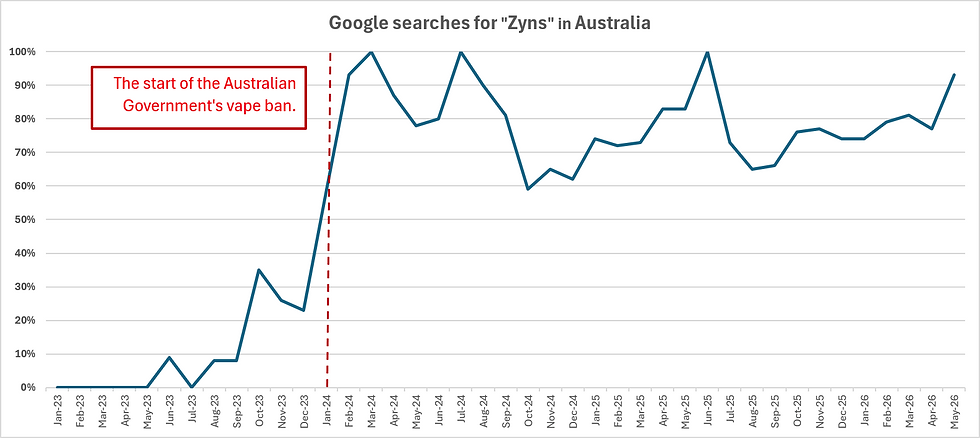
(Data: Google Trends)
The rise of searches reflects a growing awareness of nicotine pouches, leading many young people to the next question.
Where can I access nicotine pouches?
Durl believes there’s no shortage of ways for young Australians to get around prohibited nicotine products. He frequently visits high schools across New South Wales to provide drug and alcohol education, and finds that the most insightful conversations are those he’s had with students.
“If kids know what [nicotine pouches] are, they know how to get them,” he says.
A quick google search of ‘Zyns Australia’ will reveal multiple online sellers. Some require a prescription from a medical practitioner, others do not. Those who choose to take the legal route can find websites that offer prescriptions through completing a questionnaire.
(Via: Leia Vlahos)
Durl recalls chatting to students— as young as 12— from Sydney’s West, who named the exact store within the local shopping centre that sold nicotine pouches. He was concerned by "literal backdoor" sales from non-tobacconist outlets, including supermarkets and clothing retailers. He says legalities are not the first concern on underage Australians' mind when considering nicotine products. Researchers believe the discreet nature of the products contribute to why young people are drawn to nicotine pouches.
“People might be using nicotine pouches in environments where they wouldn’t otherwise be smoking or vaping… going to the cinema, on planes, at school,” Gildea says.
Gildea suggests that nicotine users may start using vapes at first, then switch to nicotine pouches when they start to notice withdrawal symptoms, are in an no-smoking area and cannot vape and need a "top-up". She says it could start with sharing a pack of cigarettes with mates at the pub, then switch to vaping at home because there’s no ash to clean up, then using a nicotine pouch when you’re studying for exams or on a long road trip with family.
“Nobody is silly for trying these products… it’s the industry that's really the problem here,” she says.
“You will not focus more, you will not be better at sport. These products are designed to make more money by deteriorating your health."
Similarly, Durl believes a lot of people don’t understand how addiction works.
Addiction and dependence
After experiencing his rough night on Hindley Street due to the symptoms of nicotine pouches, Smith questioned if he should continue his use. He says he’s bought four tins of nicotine pouches since learning of them two years ago, but would not buy anymore as he doesn’t enjoy the symptoms.
He attributes his social circle to contributing to what products are considered “cool”. He believes the stereotypes of those who take Zyns are not the people he’d align himself with.
“I’d say Zyns are more Republican coded ‘cause they’re big in the US… what’s cool [in my group] is French cigarettes,” he says.
Although trends may differ among varying social groups, researchers believe their use is becoming increasingly normalised across a range of environments, such as youth sports.
Stephen Bird* plays soccer at a semi-professional level in Adelaide’s north, and believes nicotine pouches are ingrained in the sport’s culture.
“I’ve played at three clubs for the past four seasons … I haven’t been at a club where someone hasn’t been addicted,” he says.
Players will commonly use nicotine pouches in change rooms before and after games, Bird says. He’s seen games with the goalkeeper using them mid-game and keeping the can in the net’s corner.
Bird believes the higher achieving the team is, the higher percent of players are using nicotine pouches. In his team, half of the squad is “hooked” and he estimates 75 per cent of the club’s first team is addicted.
Unlike Smith who uses nicotine pouches for the physical side effects, Bird’s teammates choose to take nicotine pouches to alter their mentality. Older, experienced players will often encourage 17 to 20 year-old players to take nicotine pouches to calm their nerves and ease the pressure of playing at such an advanced level.
“The higher level you play in any sport, you have a lot more access to all those things, because everyone is trying to find enhancement in any sort of way,” he says.
He believes soccer fans across the globe have been influenced by prominent names in the industry endorsing nicotine pouches. A 2024 survey found one in five soccer players in the United Kingdom are using snus, nicotine pouches, or both.

Sunderland’s Bertrand Traore and Newcastle United’s Mark Gillespie appear to place something in their mouths during Premier League games. (Image: The Athletic)
“[People believe] if the best in the world are doing it, it can’t be that bad,” he says.
“The team physios and nutritionists know. It’s so common throughout the league, [the federation] would have to know.
“You have, like, people who are doing steroids and that, so [nicotine pouches] are probably one of the lower level concerns in that environment.”
As stimulants are increasingly normalised in sporting environments, public health experts warn that illicit products may be undermining efforts to minimise nicotine use.
Profits versus public health
Quitting smoking products is now more expensive than illicit tobacco in Australia, according to a 2026 study.
In Australia, subsidised Nicotine Replacement Therapy (NRT) treatments are limited to two 12-week courses per year, the study says. Purchasing these products over the counter from a supermarket or pharmacy can range from approximately AUD$50 per four weeks’ through to several hundred dollars, particularly when using combination treatments – costs likely prohibitive for some disadvantaged Australians.

(Image: Leia Vlahos)
This study also found smoking prevalence in Australia is significantly higher among people living with mental illness, alcohol and other drug dependence, those who have experienced trauma and people facing social and economic disadvantage and is as high as 78 per cent among people experiencing homelessness.
Smith says he would use NRT gum more often instead of illicit nicotine products if the legal route were cheaper. He started purchasing NRT in 2020, but found that the cost kept increasing which led him to eventually switch to illicit products.
Phillip Morris International (PMI), the company behind many well-known nicotine brands such as Zyns, reported a net revenue of approximately AUD$57 billion in 2025, marking a fifth consecutive year of growth.

(Data: Philip Morris International)
The company’s 2025 earnings release reported 879.6 million cans of nicotine pouches were shipped across the globe, with 4.7 million of these arriving in the east Asia, Australia, and global travel retail market.
Crackdowns and regulations
Amidst this growing illicit use, the governments solutions are further crackdowns and regulations. Between January 2024 and June 2024, 1.3 million nicotine pouches have been seized at the Australian border, which is 950 per cent more than the total number of nicotine pouches seized in the two years prior. When asked to comment on the matter, SA Health Minister Blair Boyer said:
"The rise [of nicotine pouches] comes alongside rapid growth in the illicit tobacco market, with illicit products now estimated to make up 55 per cent of the tobacco and e-cigarette market.
That's why we prohibited nicotine pouches in January 2025— the first jurisdiction in Australia to do. We've also strengthened enforcement through expanded powers, tougher penalties and increased investment in compliance activity to disrupt illegal supply chains and deter repeat offending."
Australia has a world-leading record when it comes to nicotine crackdowns, but many believe there is still more to be done. SA Police and Business and Consumer Affairs Minister Michael Brown says SA is ahead of the curve fighting illicit tobacco through administering penalties of up to AUD$6.6 million and 28-day store closure orders.

(Image: Leia Vlahos)
“Consumer business services does regular raids and inspections of tobacco stores across the state and seizes nicotine pouches alongside illicit tobacco, cigarettes and vapes, however, there have not been any specific operations recently targeting nicotine pouches,” he says.
In early May 2026, the federal government reignited debates of a tobacco excise cut through a parliamentary enquiry into illicit tobacco. Australia is currently the most expensive place in the world to buy cigarettes. Without a cut, revenue is anticipated to hit 2.1 billion by 2030, a stark contrast to PMI's annual net revenue.
However, for many like James Durl, the solution lies social and cultural shift rather than restrictions. Durl questions the effectiveness of reform such as hard bans, and instead wants emphasis on more education, attention and funding. He says he hopes he will see a day when all Australians understand the harm of nicotine, meaning there’s no requirement for a ban or stricter regulations.
If you or someone you know is struggling with nicotine addiction, contact:
Quitline on 13 7848 or QUIT’s online counselling services.
*Names changed for anonymity
Comments